Games
Game Boy Advance Nostalgia Meets Mobile Play: What Handheld Gaming Taught Us About Playing on the Go

Alienware just shipped a 39-inch 5K monitor with RGB Stripe Tandem OLED technology. It’s massive. It’s gorgeous. It’s also, in a weird way, proof that gaming display size has become completely unmoored from what actually matters to most players.
Because here’s the thing nobody in the monitor press releases mentions: some of the most-played games on record were built for a screen smaller than a deck of cards.
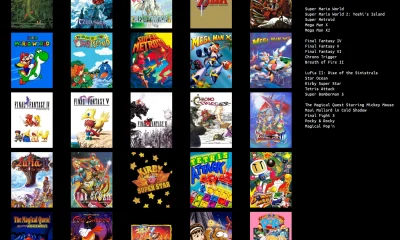
The Game Boy Advance shipped with a 2.9-inch display. No backlight on the original model. You’d tilt it toward a window like you were trying to read a map in a thunderstorm. And yet Pokemon Cloud White and The Legend of Zelda: The Minish Capstill rack up hundreds of thousands of plays today on browser emulators, decades after that screen stopped being cutting edge. Something about that tiny format worked. The question is what, and why the industry spent twenty years swinging as far from it as possible before swinging right back.
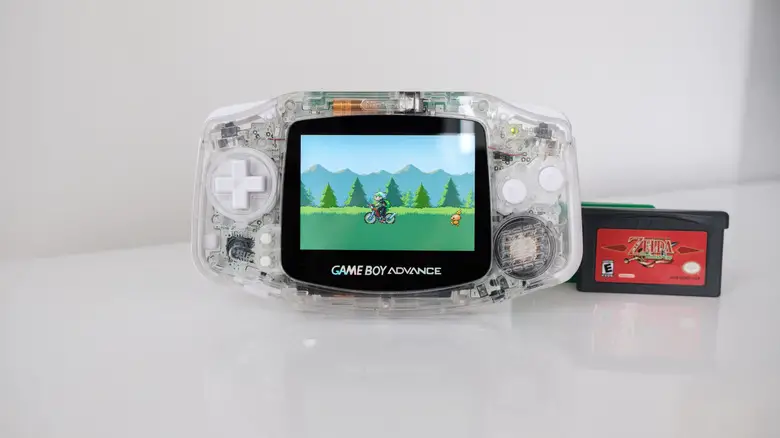
The Great Screen Inflation
Trace the timeline and it reads like a pendulum with no brakes. GBA in 2001: a 2.9-inch screen you squinted at on the bus. By the mid-2000s, gaming had moved indoors and upward, chasing 24-inch CRTs, then 27-inch LCDs, then the ultrawide craze that swallowed entire desks. Alienware’s new 39-inch 5K release is the logical endpoint of that chase. Curved, color-accurate, built for the kind of single-player immersion where you want peripheral vision full of game and nothing else.
Kotaku’s retrospective on the Game Boy Advance’s legacy makes a point that’s easy to miss now: Nintendo wasn’t chasing immersion with the GBA. It was chasing portability, battery life, and the ability to play Metroid Fusionin a car without anyone else caring. Two completely different design philosophies, both wildly successful, existing at the same company in the same decade.
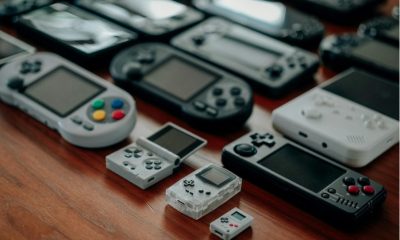
Then something odd happened. The industry that spent fifteen years building bigger screens started building smaller ones again. Steam Deck. ROG Ally. Your phone, which is now the primary gaming device for a huge share of the planet. Pocket Tactics called this out directly in a piece on 25 years of the Game Boy Advance, arguing the handheld habits Nintendo cultivated in 2001 are exactly the habits modern portable and mobile gaming now depend on. Short sessions. Grabbing five minutes on a train. Not needing a dedicated room to play.
Small Screens Never Actually Lost. They Just Got Ignored For a While
This matters for more than nostalgia. Mobile-first design didn’t spring out of nowhere in the App Store era. It’s a direct descendant of what handheld makers figured out decades earlier: if the screen is small, the interface has to work harder, the sessions have to be tighter, and the reward loop has to land fast.
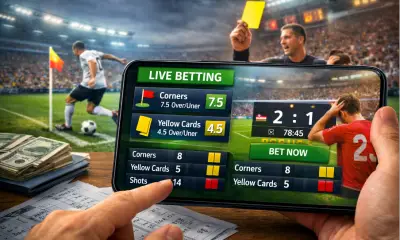
That lesson carried straight into gambling apps, which had the exact same problem to solve as GBA developers once did. Mobile casino platforms spent the 2010s learning, sometimes painfully, that a desktop-style interface crammed onto a 6-inch screen is unusable. Buttons too small. Menus too deep. Load times too long for a five-minute session on a commute. The operators who actually solved that, rather than just shrinking their desktop site, are the ones still standing. A rundown of which platforms nailed mobile UX, fast load times, and touch-friendly layouts is ranked according to New Game Network, and the pattern in that list tracks almost exactly with what made GBA titles playable in the first place: minimal friction, clear visual hierarchy, no wasted taps.
Gambling involves risk. Please play responsibly and only wager what you can afford to lose. If you feel gambling is becoming a problem, visit BeGambleAware.org or call 1-800-GAMBLER.
What Handheld Design Actually Got Right
Go back to the hardware constraints for a second, because they explain everything. The original GBA had no backlight, a four-button layout, and a battery that ate through AAs in about fifteen hours. Developers couldn’t lean on spectacle. They leaned on clarity instead. Bold sprite work. High-contrast palettes. UI elements sized for a screen you’d be squinting at in bad light.
Compare that to a 39-inch curved OLED built for 5K resolution and HDR that makes shadows look like actual shadows. Completely different problem. Completely different solution. Neither is wrong. But only one of them scales down to a phone screen without a redesign, and it’s not the 39-inch one.
BGR’s piece on retro gadgets making a comeback frames this as more than nostalgia shopping. It’s a genuine reassessment of whether bigger was ever actually better for how most people actually play, which for most people, most of the time, is in short bursts on something they’re already holding.
The Steam Deck Generation Proves the Point
If you want the clearest evidence the pendulum swung back, look at what TechRadar covered with the rise of tools like EmuDeck turning the Steam Deck into a retro gaming machine. People are voluntarily buying handheld PCs, then loading them with GBA and SNES libraries, specifically to recreate the on-the-go experience the industry spent two decades trying to engineer away from.
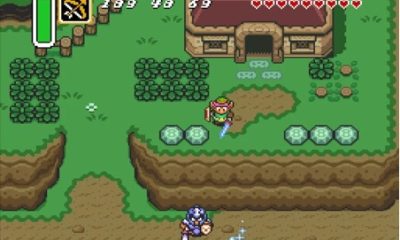
That’s not a coincidence. It’s a market correction. The Conversation’s research into why video game nostalgia works on players psychologically points out that nostalgia only resonates when it’s paired with genuine functional value, not just sentiment. A tiny screen alone isn’t nostalgic. A tiny screen that lets you actually finish Zelda: A Link to the Pastbetween two subway stops is functional nostalgia. That’s the version that’s making a comeback, not the version that just looks retro on a shelf.
Where This Actually Lands
Big monitors aren’t going anywhere. Alienware didn’t build a flop. There’s a real, growing market for players who want a cave-like setup and a screen that swallows their whole field of view for a 40-hour RPG. Fine. Great, even.
But the idea that bigger screens represent “progress” while smaller ones represent a phase we grew out of never held up. It just took the industry twenty-five years and a stack of Steam Deck sales figures to admit it. The GBA generation knew this instinctively. Short sessions. Anywhere access. No ceremony required to start playing.
FAQ
Why did gaming screens get so much bigger after the Game Boy Advance era?
Desktop and console gaming chased immersion through display real estate once flatscreen TVs and monitors got cheap. Bigger screens supported richer detail and wider fields of view, which suited the single-player, sit-down experiences that dominated gaming through the 2000s and into the 2010s.
Is handheld gaming actually growing again, or is this just nostalgia marketing?
Sales data on devices like Steam Deck and ROG Ally, plus the popularity of retro emulation tools, point to real demand, not just marketing. People want short, portable sessions again, and hardware makers are responding with real product lines, not just retro-styled branding.
What made Game Boy Advance games playable on such a small screen?
Tight visual design. Developers used bold sprites, high contrast, and simplified UI because they had no backlight and limited resolution to work with. That discipline is exactly what modern mobile app designers now study when building for small touchscreens.
Do bigger monitors actually improve gameplay, or just visuals?
Mostly visuals and immersion, not mechanical skill. Competitive players often prefer smaller, high-refresh monitors for reaction speed. Alienware’s 39-inch 5K panel is built for cinematic single-player experiences, not competitive precision.
Will phone screens ever fully replace dedicated gaming hardware?
Unlikely to fully replace it, but they’ve already replaced it for a huge share of casual play. Dedicated hardware still wins for graphically demanding or competitive titles, while phones dominate short-session, on-the-go gaming, a split that looks a lot like the desktop-versus-handheld divide of the early 2000s.
By Marcus T. | Retro gaming and handheld tech writer, 9 years covering consumer electronics. Tested September 2026.