Sometime between the PlayStation 2 era and today, the gaming industry made a decision nobody voted on: size would replace soul. In 2026, gamers across the world, millennials chasing childhood ghosts and Gen Z players stumbling onto pixelated classics through TikTok rabbit holes, are abandoning sprawling AAA productions for the stripped-down honesty of retro gaming, not out of sentimentality, but out of exhaustion that has been building quietly for years.
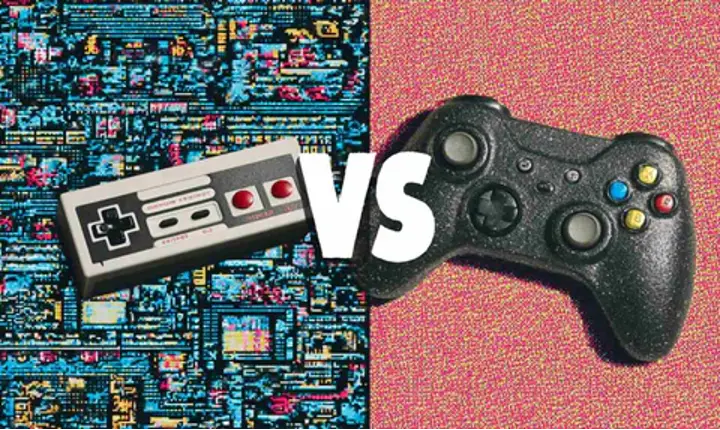
The numbers don’t need dressing up: the global retro gaming console market sat at $3.8 billion in 2025, tracking toward $8.5 billion by 2033 at a compound annual growth rate of roughly 10%, which means this isn’t collectors hoarding cartridges in basements, but a market segment outrunning mainstream console growth by a wide margin, fed by people who have current-gen hardware gathering dust while they replay Castlevania.
Nobody asks why retro gaming is growing, because the more uncomfortable question is what modern gaming did to deserve being left behind in the first place.
Classic game design was brutal in exactly the right way: limited hardware forced developers to solve a single problem, which was making something worth playing with almost nothing to work with, and the result was titles that communicated their rules in seconds and held attention through feel rather than spectacle, whereas today’s equivalent is a forty-five minute tutorial before the first enemy appears, followed by a skill tree nobody asked for and a battle pass that expires in eleven days.
This shift isn’t exclusive to consoles; it has fundamentally reshaped the real-money gaming landscape as well. The simplicity provided by the gaming terminals in Vegas, defined by three reels triggered mechanically into a matching line, have evolved into hyper-complex online titles featuring cinematic cutscenes and intricate layers. While this evolution brought incredible variety, it also mirrored the digital bloat of the broader tech world.
The paradox of modern gaming is that more options produce less satisfaction, and that friction is exactly what comparative platforms like time2play are built to resolve, mapping a landscape so overcrowded that finding something genuinely worth playing has become its own separate task entirely. Volume was never the same thing as value, and the industry just spent a decade pretending otherwise.
The live service collapse of 2025 is where the argument stops being theoretical: according to industry tracking of 2025 releases, live service games shed up to 90 percent of their player base within months of launch, with structural failures in how progression and content were designed identified as the core problem, and of 19 major titles examined, most lost between 80 and 99 percent of their players, yet the studios knew the odds and built anyway, because one Fortnite justifies a hundred failures on a spreadsheet somewhere.
The modern gaming calendar has become an obligation machine where you log in daily or forfeit your streak, complete each challenge before the weekly reset, and buy the cosmetic now because it disappears Thursday; what was once entertainment quietly became a subscription to anxiety, with seasonal content replacing the actual game and FOMO doing the work that fun used to do.
Games industry analyst Emmanuel Rosier of Newzoo calls retro gaming “institutionalized” now, a permanent fixture rather than a passing trend, and that word choice is telling, since Rosier probably didn’t intend the irony: the games industry spent thirty years institutionalizing complexity, and what got institutionalized in return was the appetite for everything it had abandoned along the way, pushing players toward the past not because they sought it out, but because the present left them with nowhere else to go.
Retro games were built under constraints that functioned, accidentally, as quality filters: no storage for cutscenes meant the gameplay had to carry everything on its own, and no online infrastructure meant the experience had to be complete at purchase, whole and self-contained, not built, monetized, updated, season-passed, re-monetized, and quietly killed when the engagement curve flattened.
The indie sector figured this out first, which is why it’s eating the lunch of studios with fifty times the budget; developers reviving 8-bit and 16-bit aesthetics aren’t being nostalgic so much as strategic, and titles like Celeste, Shovel Knight or Sea of Stars didn’t win on looks, but because their designers treated fun as a non-negotiable deliverable rather than a feature to be patched in somewhere down the road.
The piece on the influence of retro games on modern gaming platforms is a creative dialogue between eras, though a less diplomatic reading is that the AAA sector spent a decade dismissing what retro design understood instinctively, and is now borrowing it back wholesale while calling it innovation, which is a neat trick if you can get away with it.
By 2025, access to vast game libraries had stopped translating into engagement entirely, forcing publishers into a belated reckoning with a distinction they had spent years deliberately ignoring: access is not attachment, and one subscription that gives you four hundred games you will never finish is not the same thing as the investment that made a twelve-year-old replay the Water Temple until the geometry finally made sense, something that cannot be manufactured at scale, and definitely cannot be unlocked through a battle pass.
Modern gaming earned its achievements, among them photorealistic environments, cinematic storytelling that rivals prestige television, and global multiplayer infrastructure that connects millions without friction; these are real accomplishments that matter, even if none of them answer the original question of whether any of this is actually fun to play.
But the industry made a trade somewhere along the way, and it made it quietly, without announcement: it stopped optimizing for the feeling of playing and started optimizing for the metrics of engagement, and while those two things sound similar enough to confuse on a slide deck, they produce completely different games in practice.
If a title from 1993 still competes on equal terms with a $200 million release from last year, the problem isn’t the old game.